
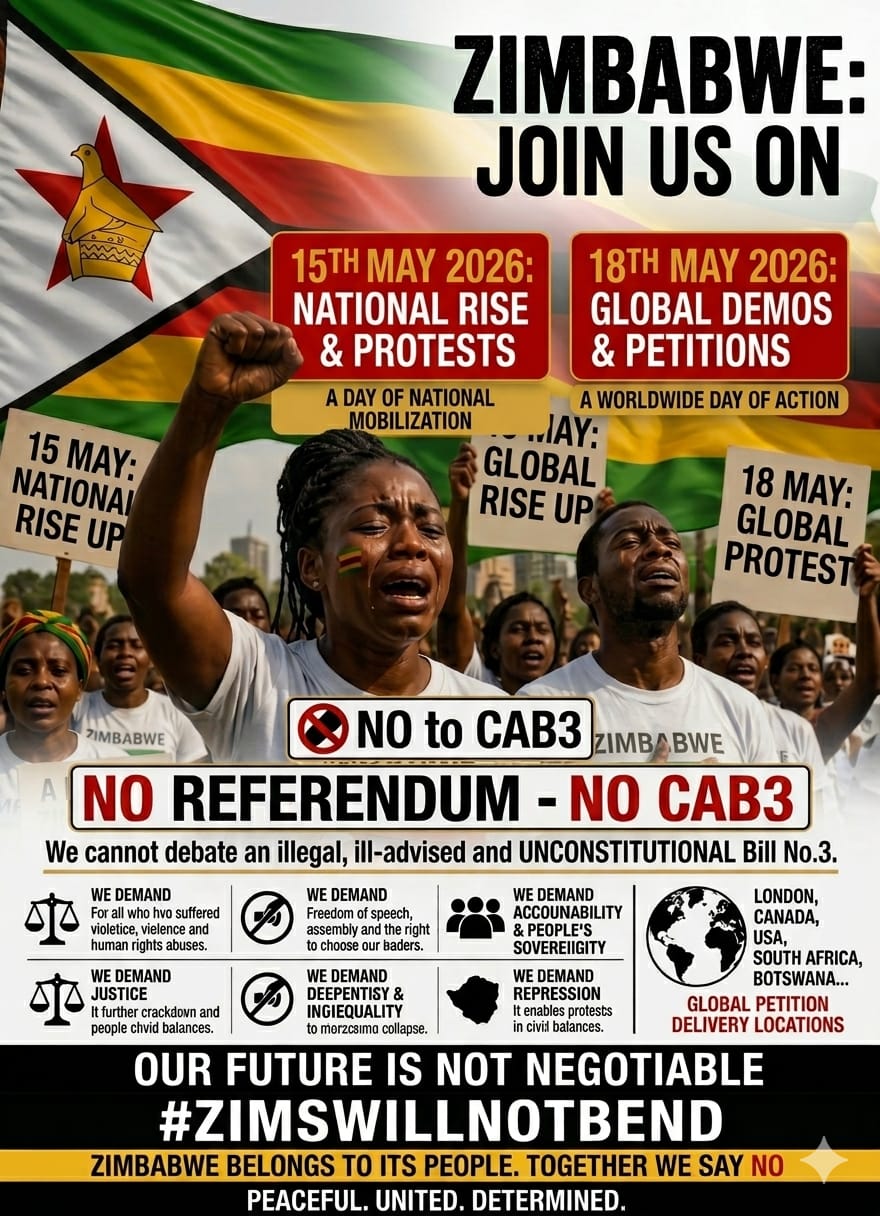
 A United Voice for Justice, Democracy, and a Referendum
Across the world, Zimbabweans continue to rise with one voice demanding fairness, accountability, and respect for their nation's future. The growing call to reject CAB3 is not merely about politics — it is about protecting the constitutional foundations that define Zimbabwe and its people.
But we must be precise about what that constitutional foundation actually demands. The 2013 Constitution of Zimbabwe is unambiguous: changes of this magnitude require a REFERENDUM — not a parliamentary vote, not a public "debate," and certainly not the regime's orchestrated propaganda exercise. CAB3, as currently constituted, is therefore not a legitimate legislative process. It is an illegal ruse.
This distinction matters enormously. The Zanu PF regime has deployed the full resources of the Zimbabwean state — media, money, and machinery — to wage a propaganda and psychological operations campaign. Its goal is to drag Zimbabweans into a debate about the merits of CAB3, as though it were a normal policy discussion. It is not. The moment we accept the framing of debate, we have already conceded the regime's central deception: that this process is lawful. It is not.
There is nothing to debate. There is only one lawful path: a referendum of the Zimbabwean people.
This is not a radical demand — it is the law. The 2013 Constitution exists precisely to prevent any government, including this one, from consolidating power through parliamentary manipulation alone. When Zimbabweans at home and in the diaspora petition against CAB3, they must do so with this clarity at the forefront:
we are not asking the regime to improve CAB3, or to consult more widely, or to slow down. We are demanding that it be recognised for what it is — constitutionally void — and that the referendum the law requires be held.
For many, this moment represents more than a protest. It is a stand for the constitution as the living foundation that guarantees order, balance, and protection for every citizen. When people come together to defend it, they are not only preserving law — they are safeguarding the dignity of generations to come.
Zimbabweans, both at home and in the diaspora, have shown remarkable resilience and unity. From the streets of Harare to gatherings in London, there is a shared determination to ensure that voices are heard and that decisions reflect the genuine will of the people — expressed through the instrument the Constitution prescribes: a referendum. Peaceful demonstrations and petitions are powerful tools. They send a clear message that the people are watching, engaged, and unwilling to be distracted or manipulated.
What makes this movement powerful is its unity and its clarity of purpose. We will not be drawn into the regime's preferred terrain of endless procedural debate. We will not lend legitimacy to an illegal process by treating it as though it merely needs amendment. We stand on one ground: the Constitution, and the referendum it demands.
Different backgrounds, different experiences, yet one common goal — to see a Zimbabwe where leadership is accountable, where laws protect rather than restrict, and where the future is built on transparency, trust, and the expressed will of the people.
As the 15th of May [and the subsequent 18th May demo] approaches, it stands not just as a date, but as a symbol — of courage, of collective action, and of hope. It reminds us that change does not come from silence, and it does not come from being drawn into a rigged debate. It comes from people willing to stand together, clearly and firmly, for what is right and what is lawful.
The message is clear: CAB3 is constitutionally illegitimate. The people of Zimbabwe demand their referendum. And together, that voice cannot be ignored.