
 Zimbabwe Human Rights Organisation (ZHRO) UK
Scarborough to Whitby, along the Cinder Track Saturday 12th September 2026
1. Introduction
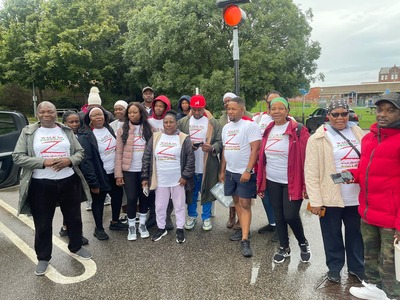
On Saturday 12th September 2026, 25 members and supporters of the Zimbabwe Human Rights Organisation (ZHRO) UK gathered in the car park of Sainsbury's, Falsgrave Road, Scarborough, to undertake a sponsored "Walk for Freedom" — a 21.8-mile (34.9 km) walk along the Cinder Track, the former trackbed of the Scarborough to Whitby railway, finishing at Battery Parade, Whitby.
It is also worth reminding ourselves that the Zimbabwe Vigil itself, thanks to Patson Muzuwa, was formed on the 12th September 2002 - so this Walk for Freedom S2W is on the 24th anniversary of that important diaspora event!
2. Building the Partnership with Sainsbury's
The walk's starting point — the Sainsbury's superstore car park on Falsgrave Road — was secured only after a period of correspondence between ZHRO and Sainsbury's head office.
- Initial approach made to Sainsbury's CEO's office, which referred ZHRO to the Community Division.
- The Community Division put ZHRO in touch with local Scarborough store management — Mark (Store Manager) and Chris (Community Champion/Officer).
- A pre-event site visit was made the week before the walk, during which a donation of 32 bottles of water for the walkers was arranged with the store.
- In addition, permission was granted for the 5 cars of the support group [and for those from far away] could stay within the Car Park for upto 12 hours - again thanks to the Local Sainsbury's.
3. The Day: Assembly and Departure
Walkers began assembling in the Sainsbury's car park from 8:00 am. Rain had been forecast, and from around 8:30 am it duly arrived — but spirits were not dampened. Around 20 plastic ponchos were distributed, and the group made the most of the conditions with photographs, singing and drumming while the final arrivals gathered.
Tea and coffee, together with a basket of fresh fruit (bananas, nectarines and satsumas), were provided by Rashiwe before departure. By the time the group of nearly 30 ZHRO members set off onto the Cinder Track, later than originally scheduled, the rain had stopped.
Transport support on the day was provided by Patson Muzuwa, who brought additional walkers to the start point. Fellow transport volunteer Yuda arrived later, having been delayed while charging his electric vehicle.
Extract from the ZHRO walk plan, showing the route split into stages between Scarborough and Whitby with timings and rest stops.
4. The Route: Scarborough to Whitby
The planned route followed the Cinder Track in stages, with rest stops scheduled at the following points:
|
Location |
Village |
Cumulative distance |
Notes |
|
Scarborough Sainsbury's car park |
Scarborough |
0 km / 0 mi |
Start point, 8:00–9:30 am |
|
Scalby |
Scalby |
3.5 km / 2.2 mi |
Short rest stop |
|
The Hayburn Wyke |
Cloughton |
10.4 km / 6.5 mi |
Local access to pub |
|
Raven Hall Road |
Ravenscar |
16.5 km / 10.3 mi |
Highest point of the route |
|
The Grosvenor Hotel |
Robin Hood's Bay |
24.2 km / 15.1 mi |
Local access to pub; longer rest |
|
The Old Railway Station |
High Hawsker |
29.0 km / 18.1 mi |
Former station site |
|
The Cinder Path Viaduct |
Whitby |
32.6 km / 20.4 mi |
Larpool Viaduct crossing |
|
WHITBY — Battery Parade |
Whitby |
34.9 km / 21.8 mi |
Finish point; bus station nearby |
[Note We did set off 2 hours behind shcedule, and spent quite some time at earch point along the route to enjoy the day, the event and to sing!
The final 4 arrived at Whitby Railway station at 20:30 - which was not too bad an achievement]
5. The Scarborough & Whitby Railway: History and Decline
The Cinder Track owes its name and its route to the Scarborough & Whitby Railway, a line whose construction was as difficult as the coastline it served.
5.1 A hard-won railway
Proposals for a direct rail link between the two resorts date back to the 1840s, but the rugged, cliff-cut terrain of the North Yorkshire coast made the scheme both technically demanding and expensive to finance. A bill authorising the Scarborough & Whitby Railway was first passed by Parliament in 1865, but the powers lapsed before construction began. A further Act followed in 1871, and building work started in earnest the following year. Money ran short and work stalled by 1877; a second Act of Parliament was needed in 1879 before construction resumed in earnest in 1881. The line finally opened to traffic on 16 July 1885 — some forty years after it was first proposed.
 5.2 Engineering along the coast
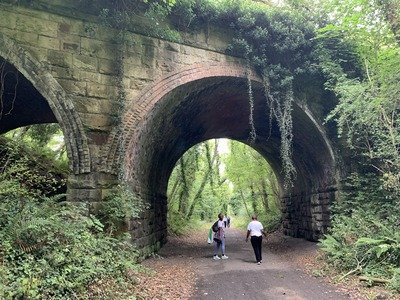
The 21-mile line was engineered to hug the coastline, threading through a succession of deep cuttings, embankments and curves as it climbed and dropped with the cliffs and dales. Its two most celebrated structures survive today as landmarks of the Cinder Track:
- The Larpool Viaduct, on the approach to Whitby — a 13-arch brick viaduct roughly 120 feet (37 m) high and around 300 yards long, carrying the trackbed across the River Esk. It remains one of the finest Victorian railway structures on the Yorkshire coast.
- Smaller overbridges and underbridges along the route (several of stone and brick construction) survive intact and are still crossed by today's walkers and cyclists.
- Photo is of a substantial bridge near Whitby which clearly indicates the amount of effort required to complete this route. This is a very large structure - brick arch and stone foundations.
5.3 Operation and its heyday
The line was operated from the outset by the North Eastern Railway, which formally purchased it from the original company in 1898. Traffic was always a mix of local goods and passenger services, but the railway found its true purpose in the growing seaside holiday trade: in the 1930s, cheap excursion fares aimed at holidaymakers brought growing numbers of visitors along the coast to Whitby, Robin Hood's Bay and the villages in between.
5.4 Decline and closure
Like many rural and coastal branch lines, the Scarborough & Whitby Railway could not compete with the rise of the motor car and coach in the postwar decades. Passenger numbers fell steadily through the 1950s and early 1960s. The line was identified for closure in the 1963 Beeching Report and, despite local opposition, closed completely in March 1965.
Scarborough Borough Council subsequently acquired the redundant trackbed. Rather than being built over, it was surfaced with cinder ballast — giving rise to the name "Cinder Track" — and opened as a long-distance footpath, cycleway and bridleway.
5.5 The Cinder Track today
The Cinder Track now forms part of National Cycle Route 1 and is a designated multi-use trail for walkers, cyclists and horse riders across its full 21.7 miles. After decades of neglect, a restoration programme — backed by the local council, the Sustrans charity (now Walk Wheel Cycle Trust) and Town Deal funding — has, since 2018, been improving the trail surface, drainage and access, and has renewed interest in the route's industrial and social history.
 6. Places of Note Along the Route
Beyond the railway itself, the Cinder Track passes through, or close to, several places of historical and natural interest that ZHRO walkers noted on the day:
- Scalby and the Scalby Beck valley, on the northern edge of Scarborough.
- Hayburn Wyke, a wooded coastal ravine and waterfall, now a Site of Special Scientific Interest and a Yorkshire Wildlife Trust nature reserve.
- Ravenscar, the highest point on the route, once promoted (unsuccessfully) as a planned Victorian seaside resort — the streets of the intended town were laid out but very few houses were ever built.
- Robin Hood's Bay, a historic fishing village with a long smuggling history, and the site of a former railway station (closed 1965) whose goods shed survives as the village hall.
- High Hawsker, near the site of a former wayside station on the line.
- Larpool Viaduct, carrying the trackbed into Whitby across the River Esk.
- Whitby itself — a town whose history stretches back to the 7th-century monastery founded under King Oswy of Northumbria, the seat of the Synod of Whitby (664 AD), and later a major centre of the alum and whaling trades and, in the 19th century, jet jewellery.
View near the Hayburn Wyke, which we have dubbed the "Valley of Hope".
7. Photographs and Photo Log
A full photo log of the day has been published by ZHRO UK on Flickr:
ZHRO Flickr Album and Contributors
A former railway overbridge on the Cinder Track — one of many surviving structures from the original 1885 line.
8. Thanks and Acknowledgements
- Sainsbury's Scarborough — Mark (Store Manager) and Chris (Community Officer), and the wider Sainsbury's Community Division, for hosting the start point and donating 32 bottles of water for the walkers.
- Rashiwe, for organising teas, coffees and fresh fruit for the walkers before departure.
- Patson Muzuwa, for transport support bringing additional walkers to the start.
- Yuda, for transport support on the day.
9. Closing Remarks
We should close with a short paragraph reflecting on the significance of the walk for ZHRO, what participants said about the day, and any next steps (further walks, fundraising totals, media coverage, thanks to sponsors) So all those who took part need to DM John Burke, with your personal storey and what you got from this fairly unique experience - so this article will be updated within the next few days
A Friendly Reply to Dr Mavaza:
On Lists, Legwork, and the Freedom to Laugh
John Burke, Zimbabwe Human Rights Organisation (ZHRO) — 14th September 2026
Article Source: From the platform : ZimbaNews
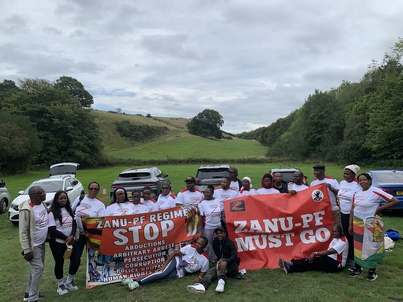
Dr Mavaza has clearly put in a shift this week. Seventy names, carefully assembled, for a walk that — according to our own published account, written before his piece appeared — had just over thirty people on it. That's not scrutiny, Doctor, that's over-catering. If you genuinely believe we've smuggled forty phantom Zimbabweans onto the Cinder Track, come and count them yourself next time. Bring a clipboard. We'll even find you a poncho, since it did rain, at first.
What's more telling is what the list crowded out. In the space Dr Mavaza spent totting up names, he could instead have mentioned the Larpool Viaduct — thirteen brick arches, forty years in the building, still standing over the Esk since 1885. Or Hayburn Wyke, which our walkers have taken to calling the "Valley of Hope," a genuine Site of Special Scientific Interest. Or the small matter that this stretch of Yorkshire coast is, by any honest account, breathtaking. None of that made the cut. A spreadsheet of names was apparently more urgent than the scenery, the history, or the fact that thirty-odd people spent a rainy Saturday singing and drumming their way to Whitby for the simple pleasure of it.
On the freedom to mock
Here is the part Dr Mavaza's piece never quite reaches: Zimbabweans in the diaspora are free to laugh at the regime's failures — the potholed roads, the rolling blackouts, the state broadcaster's talent for announcing "record harvests" in the middle of a food crisis — precisely because we are not in Zimbabwe. Try that kind of joke in Harare and you risk considerably more than a strongly worded op-ed. We know this because it is the entire reason organisations like ours exist. Over the past twelve months alone we have delivered petitions to Downing Street and the FCDO on maternal mortality, on the unconstitutional term-extension push, and on Africa Day — none of which involved banners, drums, or a single joke, and all of which Dr Mavaza's "political brand" theory conveniently ignores.
Building that confidence — the confidence to organise, to petition, to mock a government that would happily lock you up for the same joke back home — is exactly what Zimbassy is for: a space for the diaspora to build an active, self-assured community in the UK, something that simply isn't survivable inside Zimbabwe itself. As a British subject, I make no apology for encouraging that.
A word on who's actually reading this
Here's the part Dr Mavaza's own side doesn't dispute: he's spent years producing this kind of material — by some accounts two articles a day defending the party — and it has never once translated into a party position. This isn't our observation; it's a running theme in Zimbabwean commentary about him, including from outlets with no love for ZHRO. He's been described as a man ZANU-PF "will never recognise" unless you're related to the right people, still waiting for a reward that shows no sign of arriving. We made the same point back in 2021, after the COP26 episode below, when it looked very much like an attempt to earn back some standing rather than a genuine grievance about a walk in the rain.
None of which makes the arithmetic on his name-list any better. It just explains why it exists.
For old times' sake
It would be remiss not to mention that this is a considerable improvement on Dr Mavaza's last outing covering one of our events, at COP26 in Glasgow back in November 2021, when he found time between demonstrations to accuse me of personally hiring the entire crowd and — impressively multitasking — of getting rather better acquainted with the female attendees than any single weekend allows. Neither was true then, and repeating it now would age no better. This week he's confined himself to a head-count. That's progress, Doctor, and I'll take it.
The actual invitation
If Dr Mavaza wants a proper joust — funding, governance, mandate, the lot — ZHRO is happy to oblige, in the open, on the record. Just leave the guest list and the personal theories at home. We will start on those that were there shortly - but thaks for the list - we produce a table of who was, and who wasn't there for you! [Now see below].
We'll bring the drums. In fact, I welcome you to join with ZHRO and to get closer to the real Zimbabwean politic - and not the stolen version.
... and for the record, we walk for freedom, comradery, relaxation, the scenery (very important), fitness - and just for the love of it!
And finally, and very disappointing - now that the regime's acolytes have decided to target these Walk for Freedom articles we have removed the ability to vote - since the Zanu PF were marking hundreds of votes at number 1 - no doubt without actually reading the articles - if they can read of course! Prettiness personified.
Actual List of Walkers and Support
In alphabeticla order of Surnames: Rashiwe Bayisayi, (Drum and Singing) John Burke (Route Planner), Prince Chidewu, Thelma Chidewu, Dickson Chikwizo, Ella Chirunga, Melbar Dick, Nobukhosi Dube (Supplier of Hot Food!), Rosalyne Dzidzwa, Gladys Kajawo, Romeo Kambanga, Lavender Kambanga, Sonia Karumamupiyo, Anna Katsande, Shackleton Machingura, Wallace Mbayua, Francis Mubani (Driver), Patson Muzuwa (Driver, Drum and Singing), Tatenda Nyikayaramba, Bridget Parere, Tsitsidzashe T Parere, Percy Sigauke, Xoliso Sithole, Regina Vengai, Shepherd Yuda (Driver and Singing)
— John Burke