 URGENT BRIEFING
DEMOCRACY UNDER SIEGE: TENDAI BITI IN THE UK AS MNANGAGWA’S CONSTITUTIONAL STEAMROLLER APPROACHES
4–6 June 2026 • Harare London & Leicester
EXECUTIVE SUMMARY
On Thursday 4 June 2026, Tendai Biti — former Finance Minister of Zimbabwe, leader of the Constitution Defenders Forum (CDF), survivor of arrest, detention and assault at the hands of the Mnangagwa regime — arrived in the United Kingdom. His visit comes at one of the most critical moments in Zimbabwe’s post-independence history. He is speaking at Chatham House in London today at 4:00 PM and hopes to engage with the Foreign, Commonwealth & Development Office (FCDO). On Saturday 6 June, he addresses a major CDF UK Town Hall Meeting in Leicester.
He arrives in Britain with the clock ticking in Harare. President Emmerson Mnangagwa’s ruling ZANU-PF is driving the Constitution of Zimbabwe Amendment (No. 3) Bill — universally known as CAB3 — through Parliament at breakneck speed. The Bill was tabled for its First Reading on Tuesday 3 June 2026. The regime’s stated parliamentary timetable runs “until the end of June.” This is a constitutional coup in slow motion, and Biti has come to ensure the world does not look away.
THE WEEK IN FOCUS: TWO CRUCIAL EVENTS
|
TODAY — Thursday 4 June 2026 Tendai Biti speaks at Chatham House, London, 4:00 PM. He also seeks engagement with the FCDO to brief UK ministers on the crisis in Zimbabwe. |
SATURDAY — 6 June 2026 CDF UK Federation Town Hall Meeting John Foster Hall, 15 Manor Rd, Oadby, Leicester LE2 2LG 1:00 PM – 5:00 PM (Doors: 12:30 PM) All are welcome. Free to attend. |
WHO IS TENDAI BITI?
Any assessment of CAB3 and Zimbabwe’s crisis must begin with a proper understanding of the man leading the resistance. Tendai Biti is not merely an opposition politician. He is one of Zimbabwe’s most distinguished public servants, its most successful Finance Minister, and arguably the single individual most responsible for pulling Zimbabwe back from the brink of total economic collapse.
The Finance Minister Who Saved Zimbabwe
When Biti was appointed Finance Minister in the Government of National Unity in February 2009, Zimbabwe’s annual inflation rate stood at an almost incomprehensible 89.7 sextillion percent — prices were doubling every day. He dollarized the economy almost immediately. Within months, inflation had collapsed to below 1% month-on-month; by year-end, annualised inflation had turned negative at -7.7%, the lowest rate on the African continent. GDP grew 5.5% in 2009 alone; over the first two years of the GNU, Zimbabwe averaged 9% annual growth — among the fastest in the world.
He achieved this in conditions of structural sabotage, institutional mistrust and active political obstruction from ZANU-PF partners within the same coalition. He rebuilt the Treasury from nothing. He paid civil servants. He restored basic services. He is, in economic terms, the man who rebuilt Zimbabwe after Mugabe broke it.
The Price He Has Paid for Opposing CAB3
Since Mnangagwa gazetted CAB3 in February 2026, Biti has been at the forefront of the democratic resistance. He has led the Constitution Defenders Forum, participated in public hearings, written internationally, and spoken to global audiences about what is at stake. The regime’s response has been violence: Biti has been arrested, detained, and physically assaulted in the course of his opposition. He has watched colleagues abducted, lawyers beaten and robbed of phones at the very hearings designed to simulate democratic consultation.
He has come to the UK directly from this environment. His message is not academic. It is urgent and first-hand.
WHAT IS CAB3? THE CONSTITUTIONAL COUP EXPLAINED
The Constitution of Zimbabwe Amendment (No. 3) Bill — CAB3 — was gazetted by President Mnangagwa’s Cabinet on 10 February 2026 and formally gazetted by the Speaker of Parliament on 16 February 2026. It is the most far-reaching assault on Zimbabwe’s democratic architecture since independence. Its key provisions are:
- Abolition of direct presidential elections. Under CAB3, Zimbabweans would lose the right to vote directly for their President. Instead, the President would be elected by a joint sitting of Parliament — a chamber where ZANU-PF holds a dominant majority.
- Extension of presidential and parliamentary terms from 5 to 7 years, effectively extending Mnangagwa’s rule until 2030 without a fresh popular mandate.
- Restructuring of key oversight institutions, weakening independent bodies that act as checks on executive power.
- Executive control over the Zimbabwe Electoral Commission (ZEC), with a ‘Registrar-General’ figure effectively placed over voter registration.
- Senate expansion: the President gains the right to appoint 10 additional Senators, taking the Senate from 80 to 90 members and further padding his parliamentary numbers.
- Judicial appointments restructured in favour of executive influence.
Why TWO Referendums Are Constitutionally Required
This is not a matter of political opinion — it is black-letter constitutional law. Zimbabwe’s 2013 Constitution, under Section 328, provides explicit and stringent protections against exactly this kind of amendment. The Law Society of Zimbabwe, the legislative watchdog Veritas, and leading constitutional scholars including Justice Mavedzenge have all confirmed the same conclusion:
|
THE CONSTITUTIONAL REQUIREMENT Section 328 of the 2013 Constitution provides that any amendment to a term-limit provision — a provision that limits the length of time a person may hold office — cannot take effect in a way that extends the time of a person who held office BEFORE the amendment. Mnangagwa held office before this amendment. He cannot legally benefit from it. Furthermore, Section 328 is treated like Chapter 4 (the Declaration of Rights): any amendment to it requires a national referendum — a direct vote of the people. Parliament alone cannot pass this. The government’s claim that it is changing the ‘electoral cycle’ rather than ‘term limits’ is, in the words of constitutional experts, semantic gymnastics. The effect is identical. A referendum — at minimum one, and arguably two — is constitutionally required. |
The regime’s entire strategy rests on ignoring this requirement and railroading the Bill through a Parliament it controls. The ZANU-PF deadline is to pass CAB3 before 4 September 2026 — the date at which Mnangagwa’s current term began to ‘count’ — in order to maximise the extension of his tenure.
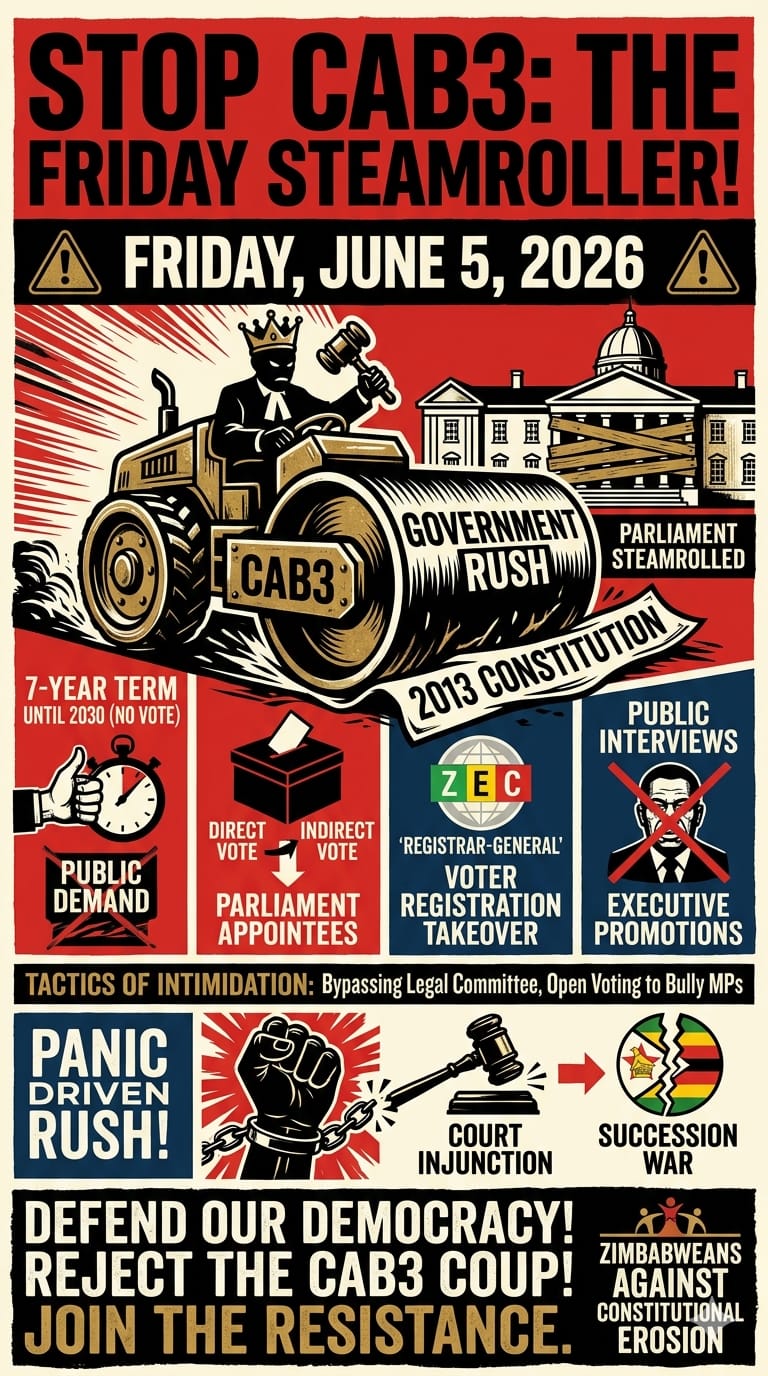
THE FRIDAY STEAMROLLER: CAB3 IN PARLIAMENT THIS WEEK
|
CRITICAL DEVELOPMENT — 3 JUNE 2026 Justice Minister Ziyambi Ziyambi tabled CAB3 in the National Assembly for its First Reading on Tuesday 3 June 2026, the day before Tendai Biti’s arrival in the UK. The regime’s stated timetable runs ‘until the end of June.’ Parliamentary sources and campaigners warn the regime is seeking to push through a Second Reading and committee stage with maximum speed and minimum scrutiny. |
The Mechanics of Intimidation
The regime is not relying on persuasion. The tactics being deployed to push CAB3 through Parliament include:
- No secret ballot. Open, whip-controlled voting: Justice Minister Ziyambi has declared there will be no secret ballot. MPs must vote in public, exposing any dissenter to immediate party discipline.
- PLC bypassed. Parliamentary Legal Committee bypassed: CAB3 was deliberately structured to avoid scrutiny by the Parliamentary Legal Committee, removing a standard constitutional safeguard.
- Legal challenge. Court papers served on MPs: On 2 June 2026, all 210 constituency MPs were personally served with court papers demanding that CAB3 be subjected to a referendum. Legislators were caught off guard.
- Military opposition. War veterans and retired generals in opposition: A group of retired military officers, led by retired Air Vice-Marshal Henry Muchena, formally petitioned Parliament against the Bill, invoking the principles of the liberation struggle.
- Public record. Over 300,000 public submissions: Parliament received more than 300,000 written submissions during the consultation period. The overwhelming majority opposed the removal of direct elections and the extension of terms.
- However, today (4th June 2026) the regime makes outrageous claims to the contrary! See article HERE (opens in New Window - as it is in Zimbabwe it will be slow)
- The Headline Figure Out of more than half a million submissions received during the public consultations on CAB3, Parliament's own report claims only 2,935 opposed the Bill. The article notes this figure "raises eyebrows" — which is quite the understatement. newzimbabwe
- The In-Person Hearing Figure is Even More Implausible Of those who actually attended the nationwide public hearings in March, just 386 people are recorded as having rejected the proposed amendments. Given what we documented about those hearings — bused-in ZANU-PF supporters, cut microphones, Doug Coltart assaulted, opposition groups withdrawing entirely — this figure is a direct product of a manufactured process. newzimbabwe
- The Urban Attendance Contradiction In Harare Metropolitan Province alone, 11,039 people attended the hearings — yet the report concludes there was overwhelming support for the Bill. Anyone who observed those hearings knows what actually happened in Harare. newzimbabwe
- The Regime's Justification for Longer Terms The report argues that the majority of submissions favoured longer electoral cycles because reducing election frequency "mitigates the immense fiscal burden on the state" and eliminates the "perpetual campaign mode" that disrupts governance — framing the removal of democratic accountability as an administrative efficiency measure. newzimbabwe
- The ZHRO Analysis in Plain Terms: The arithmetic is simply not credible. We know from the earlier ZHRO report that Parliament received over 300,000 written submissions, the vast majority opposing the Bill. Now the regime's own parliamentary committee is claiming only 2,935 of 500,000+ submissions opposed it — a figure of 0.587%. In a country of 16 million people, where opposition parties, civil society, war veterans, retired generals, the Law Society and constitutional scholars have all publicly opposed CAB3, the regime wants the world to believe that barely 3,000 people out of half a million objected. This is the statistical fingerprint of a rigged consultation — and it has now been placed on the parliamentary record to justify ramming CAB3 through. It should be cited in every international briefing, including Biti's Chatham House address today. Would you like me to add this as an addendum to the ZHRO Word report?
Why the Rush?
The Mnangagwa regime’s urgency is not constitutional — it is political. ZANU-PF needs CAB3 passed before 4 September 2026, when Mnangagwa’s current term of office technically began. Failing that deadline reduces the extension of his rule. The stampede through Parliament this week is driven not by the public interest but by the personal and factional interest of one man staying in power.
Meanwhile, a succession war is raging within ZANU-PF itself. CAB3 has exposed deep fault lines inside the ruling party. Multiple factions have different interests in the outcome. The Constitutional Court faces a challenge from war veterans arguing the entire process is unconstitutional. The Bill is legally contested, politically contested, and publicly opposed — yet the steamroller drives on.
 BITI IN THE UK: WHY THIS VISIT MATTERS
Tendai Biti’s arrival in Britain on 4 June 2026 is not coincidental. It places one of Zimbabwe’s most credible democratic voices on the world stage at the precise moment the regime is attempting to complete a constitutional coup in Harare. His programme in the UK carries strategic significance on multiple levels.
Chatham House — Today, 4:00 PM
Chatham House is the world’s foremost international affairs think tank. An address there carries immediate weight with policymakers, diplomats, academics, journalists and international institutions. Biti’s appearance today gives the anti-CAB3 case the highest-profile international platform available, at the moment it is most needed.
The FCDO Engagement
Biti hopes to visit the Foreign, Commonwealth & Development Office during his time in the UK. Direct engagement with British ministers and officials on CAB3 is critical: the FCDO has leverage that civil society does not. The UK government’s public position on CAB3 has thus far fallen short of what the gravity of the situation demands. Biti’s direct briefing could change that.
The Leicester Town Hall — Saturday 6 June
The CDF UK Federation’s Town Hall Meeting at John Foster Hall, Oadby, on Saturday is addressed by Biti directly to the Zimbabwean diaspora community in the UK — one of the most politically engaged and practically significant communities in the resistance to CAB3. Diaspora remittances exceeded $2.5 billion in 2025; diaspora voices reach every province of Zimbabwe. The Leicester meeting is not peripheral. It is one of the most important democratic gatherings of the Zimbabwean community in Britain in years.
|
CDF UK TOWN HALL MEETING — DETAILS Date: Saturday 6 June 2026 Venue: John Foster Hall, 15 Manor Road, Oadby, Leicester LE2 2LG Time: 1:00 PM – 5:00 PM (Doors open 12:30 PM) Organised by: Constitution Defenders Forum (CDF) UK Federation Contact: +44 7763 424723 | +44 7789 446169 | +44 7548 285340 Web: www.cdfzim.org | Email: |
THE LEGAL AND INTERNATIONAL REALITY
Legal Challenges Mounting
CAB3 faces multiple constitutional challenges:
-
-
-
-
- Constitutional Court: On 13 May 2026, war veterans filed a constitutional challenge in Zimbabwe’s Constitutional Court against President Mnangagwa and the Attorney General, arguing the process violates Section 328 and requires a referendum.
- MP Court Papers: On 2 June 2026, all 210 constituency MPs were served with court papers demanding a referendum before any parliamentary vote.
- Law Society: The Law Society of Zimbabwe formally submitted that passing the term-extension clauses without a referendum would breach the Constitution.
- Veritas: Veritas, the legislative watchdog, published detailed analysis confirming that extending the presidential term triggers the referendum requirement.
-
-
-
International Reaction
The international response to CAB3 has been mixed and, in some respects, alarming. The African Union met with Zimbabwean lawmakers in April 2026, but emphasised Zimbabwe’s sovereignty and right to determine its own constitutional agenda. The EU Ambassador to Zimbabwe similarly suggested the bloc had no authority to intervene in what it characterised as legitimate domestic political discussion. These stances, if maintained, would leave the regime free to complete the constitutional coup with international acquiescence.
ZHRO believes this position is mistaken and must be challenged. A constitutional amendment that abolishes direct presidential elections and extends an incumbent’s rule without a referendum is not a ‘domestic political discussion.’ It is the dismantling of democracy. The international community has a responsibility — and the UK government, with its historic relationship with Zimbabwe and its bilateral leverage, has both the standing and the obligation to act.
WHAT ZHRO IS CALLING FOR
Zimbabwe Human Rights Organisation calls on the UK Government, Parliament, and the international community to take the following steps with immediate effect:
-
-
-
-
- UK Government: Issue a formal public statement confirming that CAB3, as currently structured, requires at minimum one national referendum under Section 328 of Zimbabwe’s Constitution and that any parliamentary vote in the absence of such a referendum lacks constitutional legitimacy.
- FCDO: Engage directly with the Zimbabwean government at the highest diplomatic level to make clear that the UK will not normalise or reward the passage of CAB3 without a genuine referendum.
- International community: Support the mounting legal challenges in Zimbabwe’s Constitutional Court and make clear that the international community is watching the Court’s handling of those cases.
- Media: Amplify and platforming Biti’s visit and message — his Chatham House address and FCDO engagement represent precisely the kind of high-level democratic dialogue that should be on the public record.
- Diaspora engagement: Engage with the Zimbabwean diaspora community in the UK, which represents one of the most important conduits of democratic pressure and support into Zimbabwe.
-
-
-
CONCLUSION: TWO DAYS, TWO STORIES
This week, two things are happening simultaneously. In Harare, Mnangagwa’s regime is pushing CAB3 through a legislature it controls, bypassing the Constitution, silencing dissent, and eliminating the Zimbabwean people’s right to vote directly for their President. In London and Leicester, Tendai Biti — the man who once saved Zimbabwe’s economy and has since been jailed, beaten and persecuted for standing against this coup — is making the case for democracy before the world’s most influential audiences.
This is not a clash between two political parties. It is a clash between democracy and its dismantling. ZHRO urges all those who care about the rule of law, the rights of Zimbabweans, and the integrity of constitutionalism in Africa to take notice — and to act.
OUR CONSTITUTION • OUR RIGHTS • OUR FUTURE
Zimbabwe Human Rights Organisation | www.zhro.org.uk |
Issued: 4 June 2026