
 MANUFACTURED IMMUNITY
How Zimbabwe's “Patriotic Act” Was Drafted to Never Touch the Hands That Wield It
A ZHRO Briefing Note on CAB3, the Criminal Law (Codification and Reform) Amendment Act, 2023, and the Politics of One-Way Accountability
Zimbabwe's Criminal Law (Codification and Reform) Amendment Act, 2023 — universally known as the “Patriotic Act” — was sold to the nation as a shield for sovereignty. It criminalises any citizen who, in the state's judgement, “wilfully injures the sovereignty and national interest of Zimbabwe,” with penalties that until a 2025 High Court ruling included death, life imprisonment, loss of citizenship, and a five-year ban from voting or holding office. Its architects insisted it existed to protect the constitutional order from subversion.
Constitutional Amendment Bill No. 3 (CAB3) now gives that claim its sharpest test. If the Patriotic Act genuinely exists to protect Zimbabwe's constitutional order from those who would “subvert, upset, overthrow or overturn” it, then a bill advanced through a manufactured, coercive, and internationally condemned “consultation” process — one that strips fixed presidential term limits, concentrates judicial appointments in the executive, and weakens independent electoral oversight — ought to be the single clearest case the Act was written to catch. It is not. And the reason why is the argument.
I. A Law Built With Only One Door
Read the Patriotic Act closely and a structural fact emerges: it has no clause, no offence, and no mechanism capable of being turned against the state itself. Section 22A criminalises a citizen who meets or communicates with a foreign government “with the aim of subverting, upsetting, overthrowing or overturning the constitutional government in Zimbabwe.” It criminalises advocacy for sanctions. It criminalises participation in international forums that embarrass the state. Every verb in the statute points outward, from the citizen toward the state, or from the diaspora toward Harare. None of them point back.
This is not an oversight. It is the design. A law intended even-handedly to protect “the constitutional order” from subversion, regardless of who does the subverting, would need to contemplate the possibility that subversion could originate from within government — from a ruling party using its parliamentary majority to rewrite the constitution it swore to uphold. The Patriotic Act contemplates no such thing. It was never drafted as a neutral guardian of constitutional order. It was drafted as a weapon with a single grip, shaped to fit only the hand of the state, and only ever swung outward.
II. What CAB3 Does, Measured Against the Act's Own Language
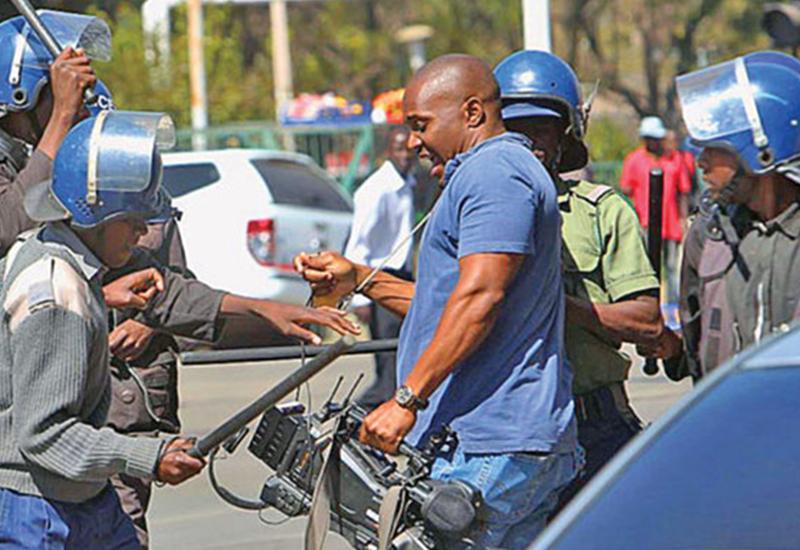
The parallel is worth stating plainly, because it is where the hypocrisy lives. CAB3, as advanced, works to remove fixed presidential term limits, shift judicial appointment power toward the executive, and narrow the independence of electoral oversight — changes that, had they been proposed by an opposition figure working with foreign partners, would fit the Patriotic Act's own definition of subverting or overturning the constitutional government almost word for word. The four-day public consultation exercise that preceded the bill's advance has already been documented, by ZHRO and by international observers, as accompanied by intimidation, gatekept microphones, assaults on participants including a drafter of the 2013 Constitution, and — in the case of Nick Mangwana's now-notorious social media post — an AI-generated image used to manufacture the appearance of enthusiastic consent where none existed.
If “subverting the constitutional government” is a crime when a citizen does it in a conversation with a foreign diplomat, the same words cannot simply cease to mean anything when a ruling party does it on the floor of Parliament.
That is not a legal technicality. It is the plain reading of the statute's own operative language, applied without the double standard.
III. Why It Still Isn't a Prosecutable Breach — and Why That's the Point
Here the honest answer has to be delivered without softening it for effect: as a matter of strict statutory construction, the architects of CAB3 have not committed a prosecutable offence under the Patriotic Act. The Act's offences are defined by reference to citizens acting through or with foreign agents against the state — not by reference to office-holders acting through domestic legislative machinery to alter the constitution. There is no textual hook. And even if there were, enforcement of the Act sits entirely within institutions — the prosecuting authority, the police, ultimately the executive — that report to the very people who would need to be investigated. A law cannot hold its own author to account when it has deliberately been built without a mirror.
This is the sharper and more durable version of the critique. It is not that the lawmakers broke their own law by accident and might yet be caught by it. It is that they wrote a law expansive enough to reach almost any citizen who criticises them, while leaving themselves categorically outside its reach — and are now using the parliamentary process that law was supposedly designed to protect in order to dismantle the very constitution the law claims to defend. The immunity is not a loophole. It is the architecture.
IV. Where Real Accountability Would Have to Come From
If not the Patriotic Act, then where? Zimbabwe's own courts have already shown the route exists: in June 2025 the High Court struck down the Patriotic Act's most severe penalty provisions (Section 22A(3)) as unconstitutional, while a companion challenge continues toward the Constitutional Court. That is the correct terrain for challenging CAB3 too — not an argument that the bill's proponents breached a criminal statute, but an argument, through constitutional review, that CAB3 itself was procured through a consultation process so compromised that it fails the 2013 Constitution's own requirements for lawful amendment, and that certain of its provisions may require a threshold — potentially a referendum — that ordinary parliamentary amendment cannot satisfy.
- Constitutional review of whether the s.328/s.331 amendment procedure was genuinely satisfied given the documented coercion and exclusion of dissenting voices during the consultation exercise.
- A referendum-threshold argument for any provision touching entrenched constitutional protections agreed in the 2013 settlement.
- Continued international pressure through UN, AU and SADC human rights mechanisms, which have already commented critically on both the Patriotic Act and the CAB3 process.
- Documentation — as ZHRO is already doing — building an evidentiary record of the consultation's conduct for use in any future accountability process, domestic or international.
V. The Argument to Make
The rhetorical case is not weakened by the legal one — it is sharpened by it. The point is not “CAB3's architects broke the Patriotic Act.” The point is that they wrote a law expansive enough to criminalise a citizen's private conversation with a foreign diplomat as an attack on constitutional sovereignty, while reserving for themselves, unreviewed and unreviewable under that same statute, the far greater power to rewrite the constitution outright. That asymmetry is the story. It should be named for what it is: a regime that criminalised subversion by everyone except itself, and then used its own parliamentary majority to do the one thing the law was ostensibly written to prevent.
Prepared as a briefing note for ZHRO advocacy and petition materials. Sources: Human Rights Watch, ICTJ, RFK Human Rights Center, Southern Africa Litigation Centre, and prior ZHRO documentation on the CAB3 consultation process.