 A Handshake and a Placard:
ZANU PF's "Investment Forum" Meets the [real] Diaspora at 429 The Strand
By ZHRO / Constitution Defenders Forum / ROHR — London, 10 July 2026
Three days after Emmerson Mnangagwa put his signature to the Constitution of Zimbabwe Amendment (No. 3) Act, the regime's embassy in London tried to sell investors on Zimbabwe. Outside, on the pavement, the diaspora explained why that pitch doesn't survive contact with the facts.
Two events, one address
Friday 10 July 2026 saw two things happen at 429 The Strand on the same afternoon, under the same roof, and neither made sense without the other.
Inside, the Zimbabwe Diaspora Business Forum – London, billed under the theme "Leveraging Diaspora Expertise for Sustainable Development" and fronted by the Financial Markets Indaba and CBZ Holdings, ran from 17:00 to 20:00. The invitation promised a "structured platform" connecting diaspora capital with Zimbabwe's "priority development projects."
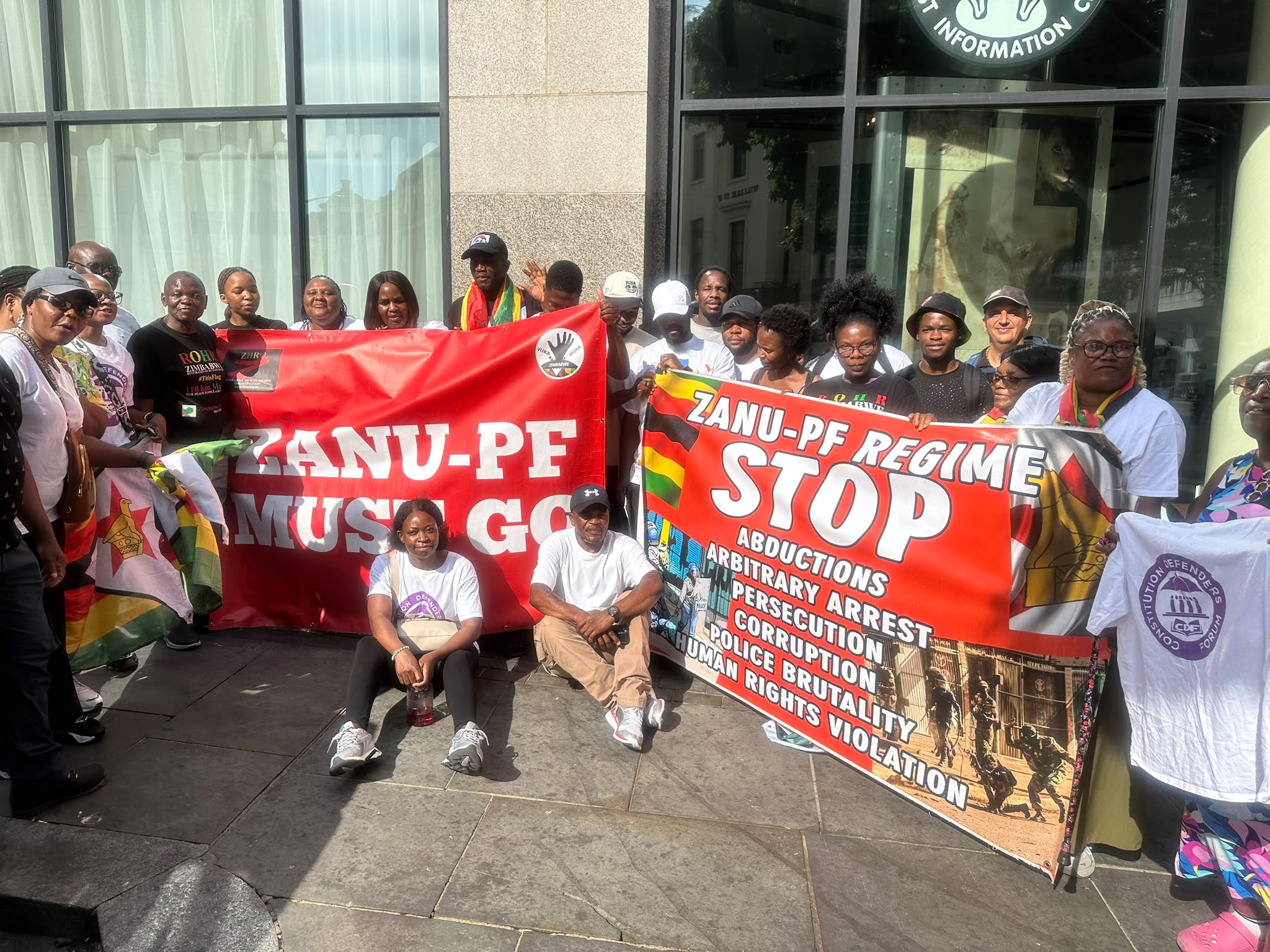
Outside, the Constitution Defenders Forum (CDF), the Zimbabwe Human Rights Organisation (ZHRO), ROHR Zimbabwe and allied diaspora groups gathered under banners reading "ZANU-PF REGIME MUST GO" and "ZANU-PF REGIME STOP: ABDUCTIONS, ARBITRARY ARREST, PERSECUTION, CORRUPTION, POLICE BRUTALITY, HUMAN RIGHTS VIOLATIONS." A Metropolitan Police Liaison Officer stood by, as he has done at every one of these demonstrations outside the embassy over the past eighteen months.
By the end of the afternoon, protesters had collected 42 signatures in the attendance register — a modest number, but a telling one when set against the turnout inside. By multiple accounts from those present, the "Business Forum" appears to have attracted essentially three actual investors: a group of UK-based businessmen in the process of setting up a deep-level gold mining operation in Zimbabwe. Everyone else in the room was ZANU PF apparatus, diplomatic staff, or diaspora figures aligned with the party — dressed, in effect, as the audience for its own success story.
Why hold an investment forum three days after signing away the ballot?
The timing was not incidental. On 7 July 2026, President Mnangagwa signed CAB3 — the Constitution of Zimbabwe Amendment (No. 3) Act, 2026, gazetted as Act No. 6 of 2026 — into law. The Act:
- Abolishes the direct popular election of the President, replacing it with election by a joint sitting of Parliament (National Assembly and Senate sitting together), a system unused since before 1987.
- Extends the terms of the President, Parliament and local authorities from five to seven years, and applies that extension to the sitting President — pushing Mnangagwa's tenure from 2028 to 2030.
- Strips the Zimbabwe Electoral Commission of core functions, transferring the voters' roll to the Registrar-General and constituency delimitation to a new, presidentially-influenced Delimitation Commission.
- Expands the Senate from 80 to 90 seats, ten of them presidential appointments.
- Abolishes the National Peace and Reconciliation Commission and removes public interviews for senior judicial appointments.
The Bill passed the National Assembly 216–42 and, after Senate amendments, cleared a recalled extraordinary sitting 226–41. The government's own figures claimed 540,037 written submissions during consultation, of which 537,102 supposedly supported the Bill — a 99.5% approval rate that civil society, the Law Society of Zimbabwe, opposition MPs and independent observers have treated with open scepticism, not least because the opening public hearing in Bulawayo was marred by overcrowding and disruption, and constitutional lawyer Doug Coltart was assaulted and had his phone confiscated during the consultation period itself. The Law Society's own legal analysis argued the changes engage Section 328(7) — the clause barring a sitting office-holder from benefiting from term-limit changes without a referendum — a question Parliament simply proceeded past. Opposition MP Fortune Daniel Molokele put the practical consequence bluntly: as an MP, nothing now stops him "in 2029 from pushing for extra years without an election."
This is the government that spent Friday evening asking the diaspora to invest in Zimbabwe's future.
What CDF and ZHRO [& ROHR, ZAPU, CCC + Chief Ndiweni] have been telling Downing Street
This demonstration did not emerge from nowhere. It sits inside a sustained campaign of formal petitions to the UK Prime Minister and the FCDO that ZHRO, ZAPU Diaspora, the Citizens Coalition for Change (CCC) Diaspora, ROHR and Chief Felix Ndiweni have run since CAB3 was first gazetted in February 2026 — through the 18 April "Independence Day" protest at the embassy, through the 15 May petition delivery on Parliament Street (delivered alongside an analytical brief drawing on a Twitter Spaces session with constitutional lawyer Doug Coltart and MPs Molokele and Hlatywayo), and now to today.
The throughline in every one of those submissions has been the same: CAB3 is not a technical adjustment to Zimbabwe's constitutional architecture. It is the entrenchment of one man and one party beyond any mechanism the electorate can use to remove them, achieved through a "consultation" process that manufactured the appearance of consent while sidelining, assaulting, and abducting those who dissented from it.
The gold beneath the gloss: why "invest in Zimbabwe" is not a simple pitch
The three UK businessmen who did show up on Friday are reportedly serious about their deep gold mining project. Whether that project will still be theirs, in any meaningful sense, by the time the first bar of bullion reaches a bank account is a genuinely open question — and it is worth setting out precisely why, because the risks are structural, not speculative.
1. The state controls the only legal route the gold can take out of the ground. All gold produced in Zimbabwe must be sold to Fidelity Gold Refinery, a subsidiary of the Reserve Bank of Zimbabwe. There is no open market. A "direct sale" route exists in theory for exceptional large-scale exporters, but even that route runs through Fidelity's facilitation and Reserve Bank Exchange Control approval — the state remains the counterparty at every stage.
2. Export proceeds are not fully the investor's to keep, and what remains is often not paid on time. Under the RBZ's 2026 Monetary Policy Statement, large-scale exporters — including gold producers — surrender 30% of foreign currency earnings to the central bank in exchange for local-currency payment; small-scale gold producers now surrender 10% under a rule introduced in February 2026, ending a full-retention regime they had previously enjoyed. The theory is a clean swap. The practice is different: as of May 2026, platinum producers alone were owed over $228 million in unpaid local-currency compensation for surrendered export earnings, with individual arrears including roughly $100 million owed to one producer and $78 million to another. Gold producers sit under the identical mechanism and face the identical exposure. Once an exporter surrenders hard currency and the promised local-currency payment doesn't arrive, they are — in the words of one industry analysis — no longer a compliant participant in a revenue-sharing scheme, but an unsecured creditor of the state.
3. The rules can move again, and have before. Zimbabwe's Indigenisation and Economic Empowerment Act once forced foreign investors to cede majority ownership to local partners; it was substantially dismantled after 2017, and gold, lithium and copper are now open to 100% foreign ownership. That reversal is presented by government officials as proof the country is investor-friendly. It is equally proof that ownership terms in Zimbabwe are a function of political convenience, reversible by statutory instrument or ministerial declaration, not a stable bedrock any investor can plan a decade around. December 2025's Statutory Instrument 215 — mandating phased local-ownership divestment of up to 75% in fourteen "reserved sectors" — is the most recent demonstration that the policy pendulum keeps moving.
4. Currency, power and logistics compound the exposure. The local currency (ZiG) into which surrendered proceeds are converted has a volatile relationship with the official exchange rate; unreliable power supply, ageing infrastructure, and the parallel-market premium that drives well-documented gold smuggling all sit on top of the payment-arrears problem.
5. There is no bilateral investment treaty umbrella to fall back on. Zimbabwe has no BIT exempting foreign investors from domestic ownership or surrender rules. Statutory protections exist through the Zimbabwe Investment and Development Agency Act — an investment licence nominally secures fair treatment, protection against expropriation, and the right to repatriate funds — but those protections are statutory, not treaty-based, and rest on the same institutions that have just rewritten the constitution to concentrate power rather than disperse it, and that are currently sitting on nine-figure sums owed to existing exporters.
None of this means a mining project in Zimbabwe cannot be built or cannot be profitable in the near term. It means the return on that gold is contingent on the goodwill and solvency of the same state apparatus that CAB3 has just placed further beyond electoral accountability — the same apparatus a handful of ZANU PF loyalists were, on Friday, trying to present to three visiting businessmen as a "success."
 Dhara: the conflicted man in the middle
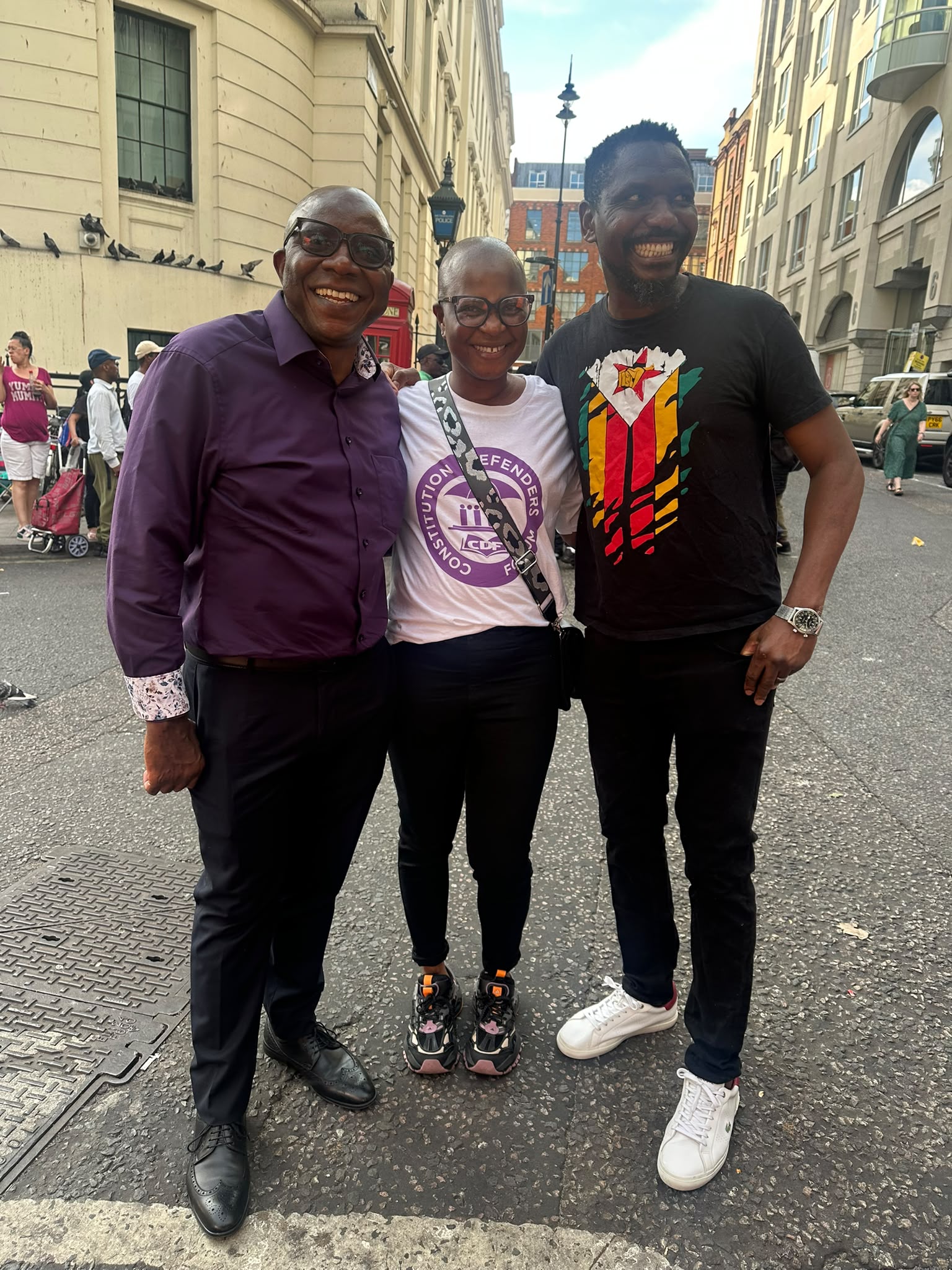
One figure moved between both worlds outside the embassy on Friday: journalist Blessed "Dhara" Mhlanga, the Heart & Soul TV news editor who spent 73 days in pre-trial detention in 2025 after interviewing a war veteran critical of Mnangagwa, and who told the Geneva Summit for Human Rights and Democracy in February 2026 that he had been jailed "for another man's speech at a press conference I did not even attend."
Mhlanga was seen in heated exchange with ZANU PF "faithful" gathered outside the embassy — and, in the same afternoon, stopped to talk with the protesters themselves. It is, in miniature, the position he has occupied publicly for years: a journalist who loves Zimbabwe enough to keep returning to it ("I am going back to Zimbabwe — it's my home and I love it," he posted after his release), and who has paid, repeatedly, for refusing to stop reporting its imperfections. He is not a CDF or ZHRO figure. He is something rarer at events like this: someone both sides feel entitled to argue with.
The record of the day
The demonstration was documented across 162 photographs and 12 videos, held in the ZHRO Flickr archive:
10th July 2026 — Zimbabwe Embassy: Full Photo & Video Album
The album captures the CDF and ZHRO banners along the Strand, the Zimbabwean flags raised against the embassy's stone façade, the Police Liaison Officer's routine presence, and the exchanges between protesters, embassy-aligned attendees, and the wider public who stopped to ask what the noise was about. Forty-two of them signed the register before the afternoon was through.
The Constitution Defenders Forum ROHR and ZHRO continue to document every demonstration outside the Zimbabwe Embassy in London and to submit formal evidence to the UK Prime Minister's Office and the FCDO on the constitutional and human rights situation in Zimbabwe. Previous submissions are referenced throughout this article; further detail is available on request.