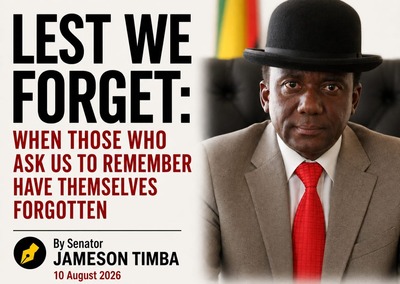
 LEST WE FORGET: WHEN THOSE WHO ASK US TO REMEMBER HAVE THEMSELVES FORGOTTEN
10 August 2026
This year's National Heroes Day commemorations are being held under a particularly poignant theme:
“Lest We Forget.”
Those words are ordinarily an invitation to a nation to remember.
To remember the young men and women who abandoned schools, universities, jobs and families to join the liberation struggle. To remember those who crossed borders into uncertainty. To remember those who were imprisoned, tortured, maimed or killed. To remember those who lie in marked graves, unmarked graves and distant lands.
- But in Zimbabwe today, “Lest We Forget” carries a painful irony.
- Because the greatest danger confronting us is not that the people of Zimbabwe have forgotten.
- It is that those governing Zimbabwe appear to have forgotten.
- They have forgotten what the liberation struggle was about.
What Did They Fight For?
Our heroes did not fight merely to replace a white ruling elite with a black ruling elite.
They did not sacrifice their lives so that a small group of politically connected people could inherit the privileges of the colonial state and distribute the country's wealth among themselves.
- They fought because Zimbabwe had to belong to its people.
- At the heart of that struggle was a revolutionary democratic proposition: one person, one vote.
- The African majority had been denied the right to determine who governed them. Political power was exercised without their consent. The liberation struggle was therefore fundamentally a struggle for sovereignty—the right of the people to determine their political future.
- That is why today's assault upon popular sovereignty is not some abstract constitutional dispute among lawyers and politicians.
It touches the very soul of our liberation.
Lest We Forget That Public Office Is a Public Trust
The liberation struggle was also a struggle against an economic system in which wealth, opportunity and privilege were concentrated in the hands of a small minority while the majority lived in deprivation.
Yet decades after independence, Zimbabwe has developed another disturbing system of privilege.
- We now speak openly about Zvigananda—powerful politically connected business interests and cartels whose proximity to political power appears, in the public mind, to provide extraordinary access to state contracts, natural resources and economic opportunity.
- Meanwhile, ordinary Zimbabweans struggle.
- Workers earn salaries that cannot sustain their families. Pensioners including Liberation War Veterans who gave their productive years to this country struggle to survive. Young graduates roam the streets without employment. Millions have left the country in search of opportunities elsewhere.
- This was not the promise of independence.
- The liberation struggle was never about transferring the feeding trough from one elite to another.
It was about creating a Republic in which the resources of Zimbabwe served the people of Zimbabwe.
Lest we forget.
Look at Our Schools
- Education was one of the great promises of independence.
- For millions of Zimbabwean families, education represented liberation itself. A child born into poverty could, through education, become a doctor, engineer, teacher, lawyer, scientist or entrepreneur.
- Zimbabwe consequently built one of Africa's proudest education systems.
- Today that achievement is under enormous strain.
The recently reported pass rate of around 3 percent among candidates qualifying for the June 2026 Ordinary Level pass-rate calculation should disturb every national leader. While the June examination cohort is materially different from the main November cohort and historically records much lower pass rates, the figure nevertheless demands serious reflection about the circumstances under which our children are learning.
We must ask what is happening inside our schools.
Teachers are struggling. Infrastructure is deteriorating in many communities. Families carry an increasing burden of financing what should be a functioning public education system.
A nation that cannot adequately educate its children is consuming its future.
Lest we forget.
Look at Our Hospitals
- Then look at our public health system.
- Women still die from pregnancy and childbirth complications that functioning health systems should increasingly be able to prevent.
- Recent UNFPA reporting puts Zimbabwe's maternal mortality ratio at 212 deaths per 100,000 live births. Behind every statistic is a mother, a child, a husband, parents and a family permanently altered by loss.
- Our hospitals struggle with shortages of medicines, equipment and personnel. Dedicated doctors and nurses frequently perform extraordinary work under extraordinarily difficult conditions.
- And yet Zimbabwe is not a country without resources.
That is what makes the deterioration of public services so morally troubling.
The question is ultimately one of priorities.
How can spectacular private wealth coexist with collapsing public institutions in a country whose liberation was supposed to deliver dignity to the majority?
Lest we forget.
The Obscenity of Conspicuous Consumption
This question becomes even more urgent when citizens encounter reports and allegations of extraordinary private wealth surrounding politically connected individuals.
There have recently been claims circulating publicly about multimillion-dollar property acquisitions and astonishing levels of expenditure associated with people linked to the highest levels of political power.
Where such allegations concern people connected to public office, they deserve credible answers rather than whispers, speculation or silence.
- I do not present unverified allegations as established fact.
- But neither should Zimbabwe accept a political culture in which legitimate questions about unexplained wealth are treated as impertinence.
- Public confidence requires transparency.
When families are struggling to put one decent meal on the table, conspicuous consumption measured in millions of United States dollars becomes more than a matter of private taste. Where that wealth intersects with political power, state contracts or access to public resources, it becomes a legitimate matter of public interest.
The heroes did not die so that a politically connected few could become obscenely wealthy while the majority watched the institutions of their Republic decay.
Lest we forget.
And Then Came CAB3
If all these things represent a gradual forgetting of the liberation promise, Constitution Amendment No. 3 represents something more profound.
On 7 July 2026, President Emmerson Mnangagwa assented to what became Act No. 6 of 2026.
The amendment fundamentally altered the constitutional settlement adopted overwhelmingly by Zimbabweans in 2013.
Among other changes, it extends presidential and parliamentary terms from five to seven years and changes the method by which the President is elected from direct election by citizens to election by Parliament.
Think about the historical significance of that.
Generations of Zimbabweans struggled for the right of ordinary men and women to determine who governs them.
And now, decades after independence, we are moving political power further away from the direct vote of the citizen.
What greater evidence could there be that those entrusted with the liberation legacy have forgotten its meaning?
The tragedy is compounded by the fact that there was a simple democratic solution available.
Ask the people.
If the architects of CAB3 genuinely believe Zimbabweans support these fundamental changes, why fear their verdict?
Put the question before the sovereign.
Let the people decide.
Heroes Day Belongs to the People
This is why this year's Heroes Day presents us with a profound moral contradiction.
The President who assented to CAB3 will preside over commemorations honouring men and women whose struggle ultimately restored political sovereignty to the African majority.
- Wreaths will be laid.
- Speeches will be delivered.
- Songs of liberation will be sung.
- The language of sacrifice, patriotism and sovereignty will fill the air.
- But ceremonies cannot substitute for fidelity to principle.
There is little meaning in laying a wreath before the Tomb of the Unknown Soldier while diminishing the sovereignty for which that unknown soldier may have died.
There is little meaning in invoking Chitepo, Tongogara, Joshua Nkomo, Jason Ziyapapa Moyo, Josiah Chinamano and countless others if we are unwilling to defend the principles that gave meaning to their sacrifices.
Our heroes deserve more than flowers.
They deserve fidelity.
The People Have Not Forgotten
Zimbabweans therefore face their own responsibility this Heroes period.
We must remember.
- But remembering must become more than nostalgia.
- Remembering must mean defending the meaning of the liberation struggle.
- Remember that Zimbabwe belongs to its people.
- Remember that public office is a public trust.
- Remember that national resources belong to the nation.
- Remember that every Zimbabwean child deserves a functioning school.
- Remember that every Zimbabwean mother deserves a health system capable of protecting her life.
- Remember that political leaders are temporary custodians of authority, not owners of the Republic.
- Remember that one person, one vote was not handed to us voluntarily. People sacrificed their lives for it.
- And remember that no generation has the moral right to take from another generation the sovereign right to determine who governs it.
That is why the struggle to restore the Constitution is not contrary to the liberation legacy.
It is an affirmation of it.
Lest We Forget
So this Heroes Day, perhaps the official theme should be directed first towards those who govern us.
- Lest you forget that independence was about the people.
- Lest you forget that political power belongs to the people.
- Lest you forget that public office is service, not entitlement.
- Lest you forget that Zimbabwe's resources belong to its citizens, not cartels and political elites.
- Lest you forget that one person, one vote was purchased with blood.
- Lest you forget that no President, Parliament or political party owns Zimbabwe.
- And above all:
- Lest you forget that the Constitution belongs to the people.
Our heroes did their part.
History now asks what our generation will do with the freedom they purchased for us.
We must answer peacefully, constitutionally and resolutely:
- Honour the Heroes.
- Defend Their Legacy.
- Let the People Decide.
- Restore the Constitution.
Zimbabwe belongs to its people.
Senator Jameson Timba is a political leader and former Minister of State in the Prime Minister's Office (2009–2013), Founding Principal of Sungano yeVanhu – Ubumbano Lomphakathi (The People's Coalition), Convenor of the Defend the Constitution Platform (DCP), Presidium member of the Progressive Alliance, and political leader.