
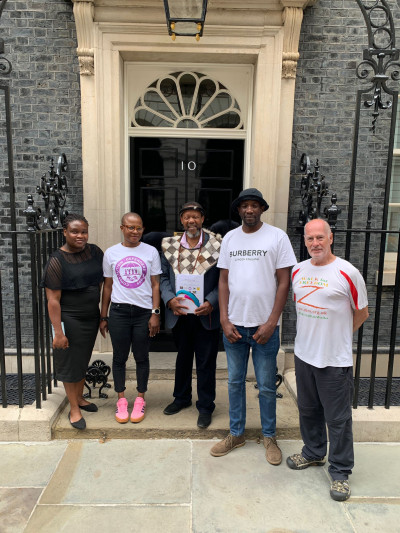
 From the Zimbabwe Embassy to Downing Street:
A Peaceful March That Demanded Justice
On 1 July 2026, Zimbabweans from across the United Kingdom gathered outside the Zimbabwe Embassy in London before embarking on a peaceful march to 10 Downing Street to deliver a petition calling for justice, constitutional reform and a better future for Zimbabwe. [See article and petition Click HERE]
The demonstration was peaceful throughout. People from different backgrounds came together with one common purpose: to express their deep concern about the political, economic and social challenges facing their country. The march was not driven by hatred or violence, but by hope that Zimbabwe can become a nation where every citizen enjoys freedom, dignity and equal opportunity.
Addressing the gathering outside Downing Street, Chief Ndiweni delivered a passionate speech, urging Zimbabweans to reflect on the country's political journey and to consider a different path for its future.
He began by comparing the political systems of the United Kingdom and Zimbabwe. He observed that the United Kingdom has had six Prime Ministers in the past ten years, while Zimbabwe has had only two heads of government in more than four decades of independence. In his view, regular leadership renewal reflects democratic accountability, whereas prolonged concentration of power can lead to political stagnation.
Chief Ndiweni also broadened his message to Africa as a whole. He condemned the rise of afrophobia in South Africa, describing it as a betrayal of African unity. He urged African leaders to protect the dignity of all Africans and warned that no nation can prosper in isolation while ignoring the challenges facing its neighbours.
Turning to Zimbabwe, he used the analogy of a football match, saying Zimbabweans have spent decades playing under rules written by those in power, making it difficult for ordinary citizens to succeed. He argued that many state institutions have become weakened, leaving citizens without the protection and accountability they deserve.
One of the central issues raised during his speech was Constitution Amendment Bill No. 3 (CAB3). Chief Ndiweni argued that the amendment strengthens political power rather than serving the interests of ordinary Zimbabweans. He said it does little to address the country's most pressing challenges, including the economy, healthcare, education and unemployment.
Many of the concerns raised in his speech were echoed by those who took part in the march.
Protesters expressed concern about Zimbabwe's political direction, arguing that democratic institutions have been weakened and that citizens' voices are not being adequately represented. They also called for stronger constitutional safeguards, respect for the rule of law and greater accountability from those entrusted with public office.
Economic hardship remains one of the greatest burdens facing Zimbabweans. Rising food prices, fuel costs and transport fares continue to place enormous pressure on families, while unemployment and informal work leave many struggling to earn a decent living. Protesters also spoke about corruption and the unequal distribution of Zimbabwe's wealth despite the country's abundant natural resources.
The deterioration of basic public services was another major concern. Hospitals continue to face shortages of medicines, medical equipment and healthcare professionals, making it difficult for many citizens to receive adequate treatment. Schools struggle with limited resources, while many communities continue to experience poor roads, unreliable water supplies and frequent electricity shortages.
Land ownership remains another issue affecting many Zimbabweans. Some families have legally purchased land, invested their life savings and built homes, only to later face disputes when the same land is claimed by powerful individuals or foreign investors. Many protesters questioned how citizens can have confidence in the rule of law if property rights are not consistently protected.
Chief Ndiweni argued that many of Zimbabwe's governance challenges stem from the highly centralised system established after the Lancaster House Agreement. He called for renewed national discussions on federalism, saying regional governments should have greater authority over local development, culture and public services, while the central government focuses on national responsibilities. He rejected claims that federalism promotes tribalism, insisting instead that it is about empowering communities, protecting cultural identity and ensuring fair representation.
Reflecting on Zimbabwe's history, Chief Ndiweni recounted the story of Prince Gubena, one of the heirs taken during the colonial era following Cecil John Rhodes' invasion. He said understanding Zimbabwe's history, identity and heritage is essential if the nation is to build a better future. [Listen to the Full Speech from Chief F Ndiweni Here on ZHRO's You Tou Tube]
Participants also expressed concern about reports of activists, journalists and ordinary citizens who have allegedly faced intimidation, arbitrary arrest or abduction after speaking out against injustice. They called for stronger protection of fundamental rights, including freedom of expression, peaceful assembly and equal protection under the law.
The peaceful march from the Zimbabwe Embassy to Downing Street demonstrated that although many Zimbabweans now live abroad, they have not forgotten their homeland. They continue to hope for a Zimbabwe where democratic institutions are respected, public resources are managed responsibly, and every citizen has an equal opportunity to succeed.
As the petition was handed over at the doors of Downing Street, the march came to an end. But for the Zimbabweans who travelled from across the United Kingdom, the journey towards a democratic, just and prosperous Zimbabwe is far from over. Their message was peaceful, their voices were united, and their hope remains unshaken.
The events of 1 July 2026 were more than a demonstration; they were a reminder that the Zimbabwean diaspora remains committed to advocating for justice, constitutionalism and respect for human rights. While opinions may differ on the solutions to Zimbabwe's challenges, the desire for peace, accountable leadership, economic opportunity and a better future is one shared by many Zimbabweans.
The march may have ended in London, but the call for a freer, fairer and more prosperous Zimbabwe continues.
---
About the Author
Rumbidzai Thelma Chidewu is a human rights activist, a member of the Zimbabwe Human Rights Organisation (ZHRO) and Restoration of Human Rights Zimbabwe (ROHR Zimbabwe), and serves as the Secretary General of the CDF UK Federation


